
Autonomy in Motion: From Roads and Farms to Blockchains
The Age of Autonomy isn’t coming — it’s already here.

Introduction: The Shift from Automation to Autonomy
Most people still think of autonomy as science fiction — fleets of driverless cars, robots that run entire factories, or AI systems that make economic decisions without humans. But autonomy is no longer a concept waiting in the wings; it’s already taking root across industries.
The shift from automation to autonomy is subtle but profound.
Automation executes predefined tasks. Autonomy decides which tasks to execute. Automation follows instructions; autonomy interprets context and acts.
Across logistics, agriculture, transportation, and even blockchain economies, systems are beginning to sense, reason, and act on their own. Together, they’re forming the early architecture of what I call the Age of Autonomy — an era where machines and software agents are not just tools, but participants in the economy.
Let’s explore four living examples:
Waymo — autonomous vehicles navigating real city streets
Greenfield Robotics — autonomous farm machines cultivating crops
Outrider — autonomous yard tractors optimizing logistics
AlphaFlux Fund (using Fetch.ai) — autonomous AI agents operating on a blockchain
Each represents a different layer of autonomy: physical, environmental, industrial, and digital.
1. Waymo — Autonomy on the Roads
The story of Waymo is the story of autonomy escaping the lab and entering traffic.
After more than a decade of research, Waymo’s fully driverless taxis now operate in Phoenix, San Francisco, and Los Angeles — navigating complex environments without a human at the wheel.
Each Waymo car senses its surroundings through LiDAR, radar, and cameras; interprets traffic flow using neural networks; and makes independent driving decisions — merging, stopping, yielding, and rerouting dynamically. It continuously updates its internal world model and shares that learning fleet-wide.
In short, Waymo cars see, think, and act.
Humans are no longer remote-controlling them — they’re teaching them how to learn.
Why it matters:
Waymo demonstrates autonomy in high-entropy environments — unpredictability, weather, human behavior.
It validates the closed-loop cycle of perception → prediction → planning → action → feedback.
And it raises social questions: trust, liability, and how societies adapt to machine decision-making in public spaces.
2. Greenfield Robotics — Autonomy on the Farm
In the quiet plains of Kansas, Greenfield Robotics builds small, solar-powered field robots that autonomously weed and cultivate crops. They don’t rely on herbicides or heavy tractors. Instead, each robot uses computer vision to identify weeds, slice them from the soil, and move to the next plant — all while communicating with others in the fleet.
This is autonomy applied to biological complexity.
The robots interpret sunlight, soil moisture, terrain slope, and plant morphology. They adapt routes in real time and optimize energy consumption across solar cycles.
The farm becomes an autonomous ecosystem — a network of self-directed machines collaborating on regenerative agriculture.
Why it matters:
It reduces chemical use and labor dependency while increasing yield.
It exemplifies decentralized intelligence: dozens of micro-robots cooperating rather than one centralized machine dictating behavior.
It hints at a future where autonomy extends into the biosphere — not to dominate it, but to manage it sustainably.
3. Outrider — Autonomy in Industrial Logistics
At the industrial level, Outrider automates the “last yard” — the chaotic zone between a warehouse and the open road.
Its driverless yard tractors connect trailers, move them between loading docks, and reposition them around the facility. Each tractor navigates by GPS, radar, and computer vision — identifying obstacles, scanning trailer barcodes, and adjusting routes dynamically.
The yard is a microcosm of the future autonomous enterprise:
Structured enough for control,
Dynamic enough to require adaptive intelligence,
Economically critical enough to justify autonomy.
Outrider’s systems integrate with warehouse management software, allowing digital coordination between human-run operations and autonomous vehicles.
Why it matters:
It showcases autonomy in semi-structured environments where predictability meets variation.
It improves throughput, reduces idle time, and minimizes labor risk.
It shows how autonomy can be incrementally integrated into legacy industrial systems without full replacement.
4. AlphaFlux Fund — Autonomous Agents on the Blockchain
Finally, autonomy has reached a purely digital frontier: AI agents that act independently on blockchains.
Rather than focusing on Fetch.ai as the protocol, let’s look at a user leveraging it — a hypothetical yet realistic crypto fund called AlphaFlux.
AlphaFlux uses Fetch.ai’s open-source agent framework to deploy a swarm of autonomous trading agents that manage parts of its portfolio around the clock.
These agents are not “bots” executing static scripts; they’re decision-making entities that perceive markets, optimize portfolios, and execute transactions independently.
How AlphaFlux’s Agents Operate
Registration & Identity
Each agent is deployed on the Fetch.ai network with its own wallet, cryptographic identity, and strategy parameters. It’s registered on-chain in the Almanac Registry so other agents or protocols can discover and interact with it.Perception
The agent constantly listens to on-chain data (token swaps, liquidity depth, yield rates) and off-chain signals via oracles (price feeds, volatility indices). It “sees” the market as a dynamic landscape.Decision & Negotiation
Suppose one agent detects an arbitrage opportunity between a DEX on Ethereum and another on Cosmos. It calculates spread, gas, and latency; negotiates with liquidity agents; and decides whether the trade meets its risk/return criteria.Execution
Once decided, it signs and submits the transaction on its own. No trader clicks “confirm.”
If conditions shift mid-execution, the agent can cancel, reroute, or retry autonomously.Learning & Adaptation
Agents can update parameters over time, adapting to market volatility or slippage data. Some even share insights with peer agents in a federated manner — a kind of machine economy teamwork.Auditability
Every decision, trade, and contract call is logged on-chain, providing a perfect audit trail. Humans retain supervisory control but intervene only for governance, not daily decisions.
What Makes This Truly Autonomous
Unlike traditional algorithmic trading bots, AlphaFlux’s agents satisfy the autonomy cycle:
Perceive: Constantly monitor changing data.
Reason: Evaluate alternatives in context.
Act: Execute decisions independently.
Learn: Update strategies without human push.
This is what I call digital autonomy — where software doesn’t just follow code but interprets context and acts with agency.
Why it matters:
It represents autonomy without physical embodiment — the evolution of autonomous economics.
It blurs the line between “organization” and “organism.” A fund becomes a living network of agents pursuing shared objectives.
It scales infinitely: 10,000 agents could manage 10,000 micro-portfolios in parallel, adapting faster than any human desk.
Risks and Open Questions
Security: What if an agent’s key is compromised?
Alignment: How do you ensure agents remain faithful to the fund’s objectives?
Coordination: What happens when autonomous agents interact competitively in DeFi markets?
Ethics & Regulation: At what point does an agent’s decision become legally accountable?
We’re now in the early days of these discussions — but make no mistake, they’re coming. Just as self-driving cars forced us to redefine liability on the road, on-chain agents will force us to redefine liability in code.
Connecting the Dots: The Anatomy of Autonomy
Across these four domains — streets, fields, yards, and blockchains — we can observe a universal architecture of autonomy:
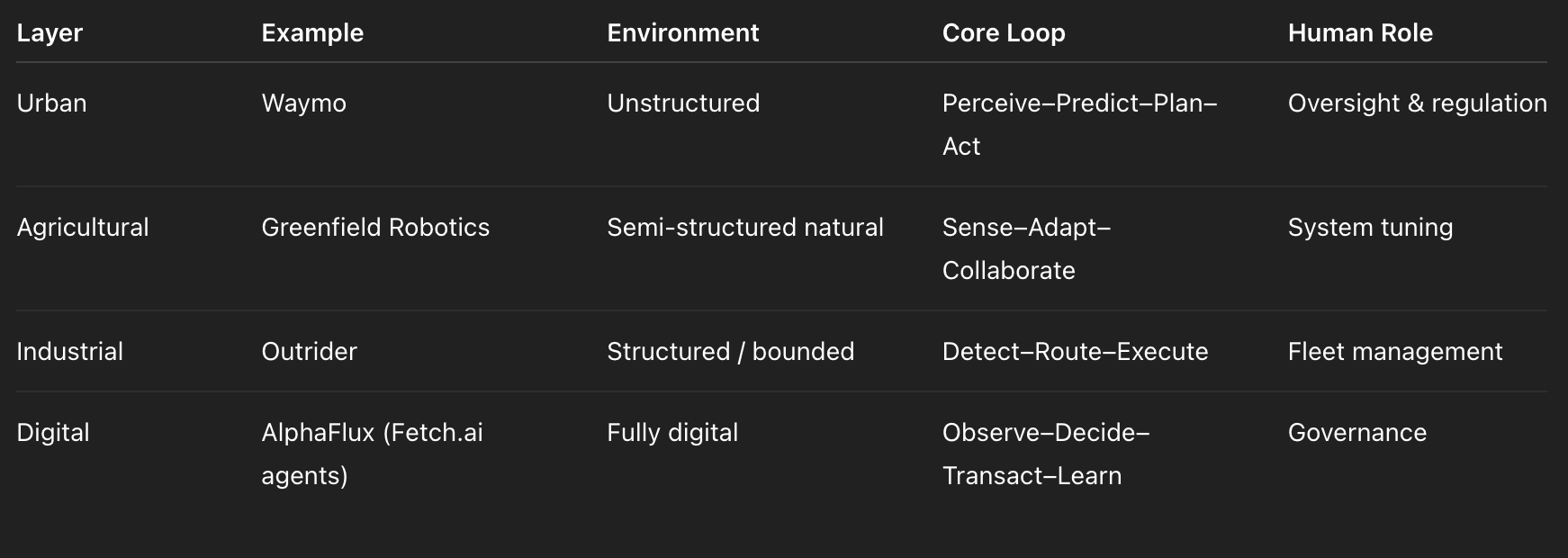
The environments differ, but the principles converge.
Each autonomous system:
Perceives its environment
Decides within constraints
Acts independently
Learns from feedback
That cycle — across machines, code, and even markets — is the foundation of the Age of Autonomy.
Conclusion: The Rise of Autonomous Economies
Autonomy is no longer just about robots; it’s about agency.
We are witnessing the birth of self-directed systems in logistics, agriculture, mobility, and finance — each a microcosm of what’s to come.
Imagine these domains converging:
Waymo’s fleets shipping goods managed by Outrider’s yards, carrying produce grown by Greenfield robots, financed by AlphaFlux’s agents.
Every node — physical or digital — capable of sensing, deciding, and transacting autonomously.
That is the Age of Autonomy — a world where intelligence and capital no longer need constant human permission to act.
It’s both exhilarating and unsettling. But if we guide it wisely, it could become the most productive coordination system humanity has ever built.
Cheers,
Jake Ryan
CIO Tradecraft Capital
Author, Crypto Investing in the Age of Autonomy
Author, Crypto Decrypted